

Your Supply Chain Is Automated. So Why Do You Still Lose Sales, Margin and Retailers?

Executive summary: Most retailers have already automated their supply chains — forecasts, reorder points, safety stock, and purchase orders. Yet shelves still empty on the day demand spikes; working capital still sits frozen in dead stock, and retailers still churn before anyone notices. This article looks at why rule-based automation keeps producing these losses, what an autonomous supply chain does differently — it senses change, decides what to do, and acts continuously, with people in control — and how Supply Quotient turns forecasting into decision-making across demand, inventory, assortment and retailer retention.
The Retail Automation Paradox
Most retailers already have forecasting systems. They calculate reorder points, maintain safety stock, and generate purchase orders on schedule.
And yet the shelf still goes empty on the day to demand spikes. The warehouse still carries slow-moving inventory; nobody chose to run down. New products still launch a little more than a planner's best guess.
None of this is a failure of automation. Every system did exactly what it was configured to do. The problem is not that the automation is broken; it is that the design was built to follow rules, and retail does not run on rules.
A Rule Is Not a Decision
Rule-based automation is instruction-following: reorder when inventory falls below the threshold. It is fast, consistent, and blind to anything the rule did not anticipate.
But retail reality is made of the things a rule cannot anticipate. A heatwave triples beverage demand in a week. A regional festival changes what sells, and where. A competitor's promotion pulls volume away overnight. A supplier's delay quietly changes what is even available to sell.
None of this trip is a reorder rule. All of them change the right decision. The system keeps following the instruction; the business needed judgement, and judgement means deciding continuously, as conditions change, not once a week when the report runs.
That gap between following a rule and deciding is where automation ends, and autonomy begins.
What an Autonomous Supply Chain Actually Does
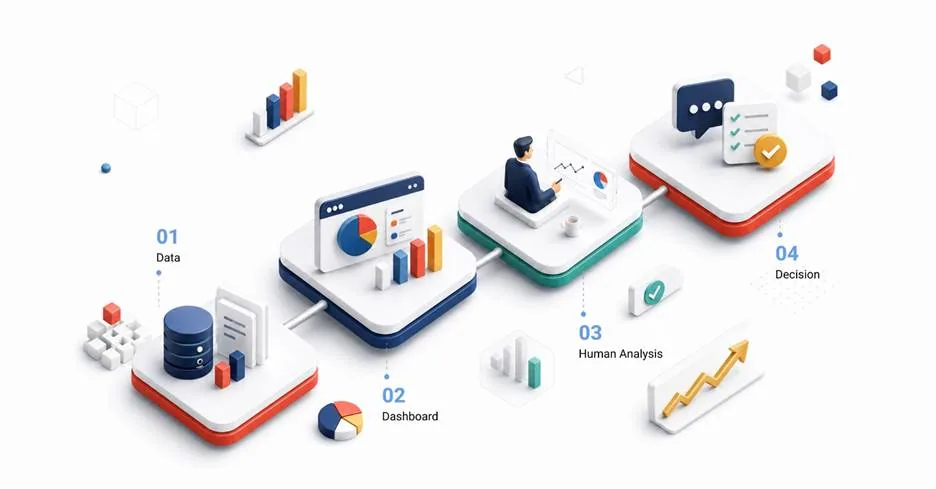
Automation runs a forecast on a schedule and hands on a planner on a number to act on, often days after the moment that mattered. Autonomy is different in kind, not degree: an autonomous supply chain senses change as it happens, reasons about what it means, and recommends the action continuously, with a human approving the moves that carry weight.
Take the heatwave. Under automation, last week's forecast never saw it; by the time a planner reacts to the dip, the beverages have already sold out in the stores that needed them and sat untouched in the ones that didn't. An autonomous system sees the temperature spike, and the early demand shift together, revises the forecast for the affected stores, and recommends the stock to move before the shelf empties not after the week closes.
Meet Supply Quotient
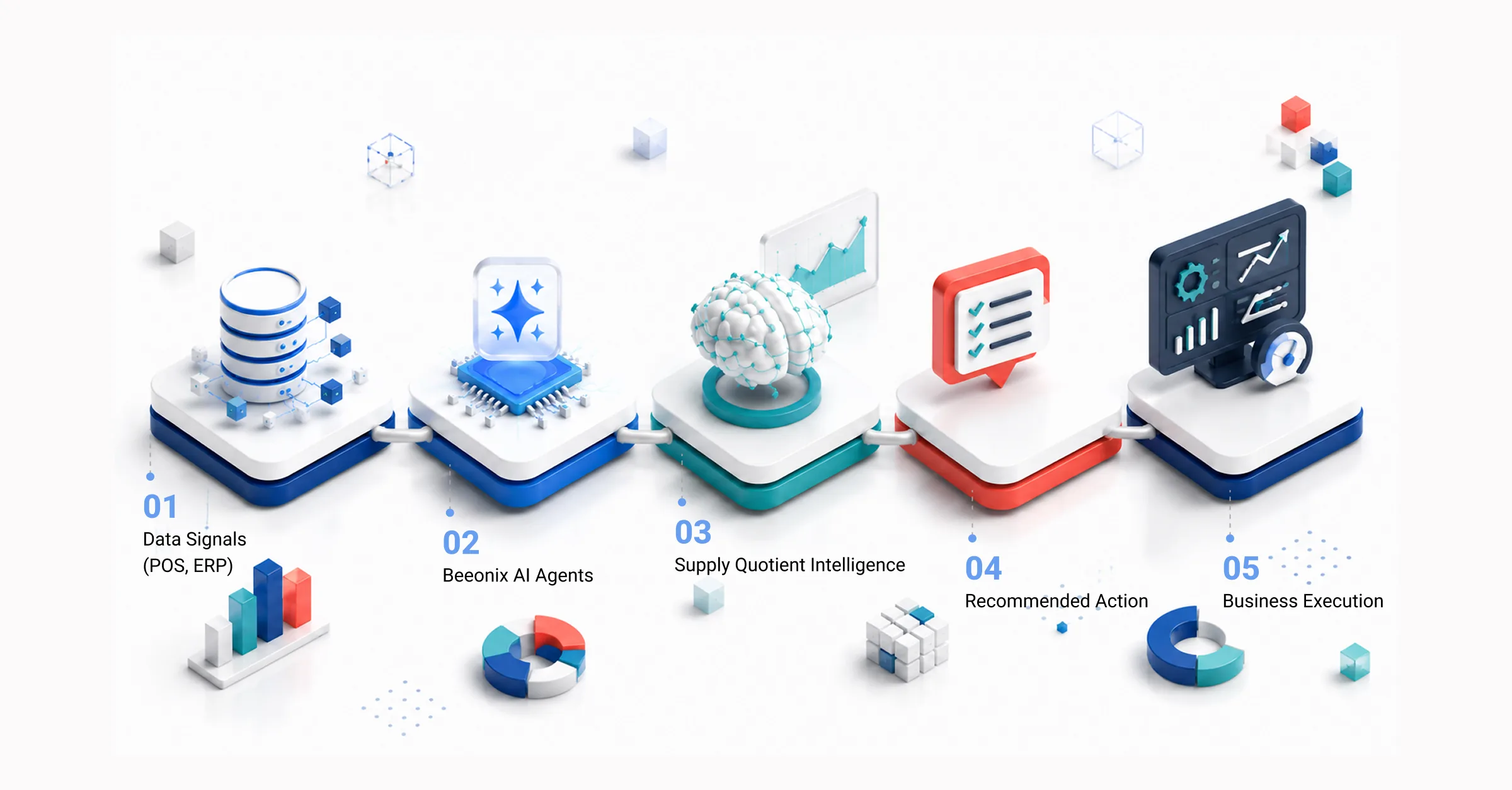
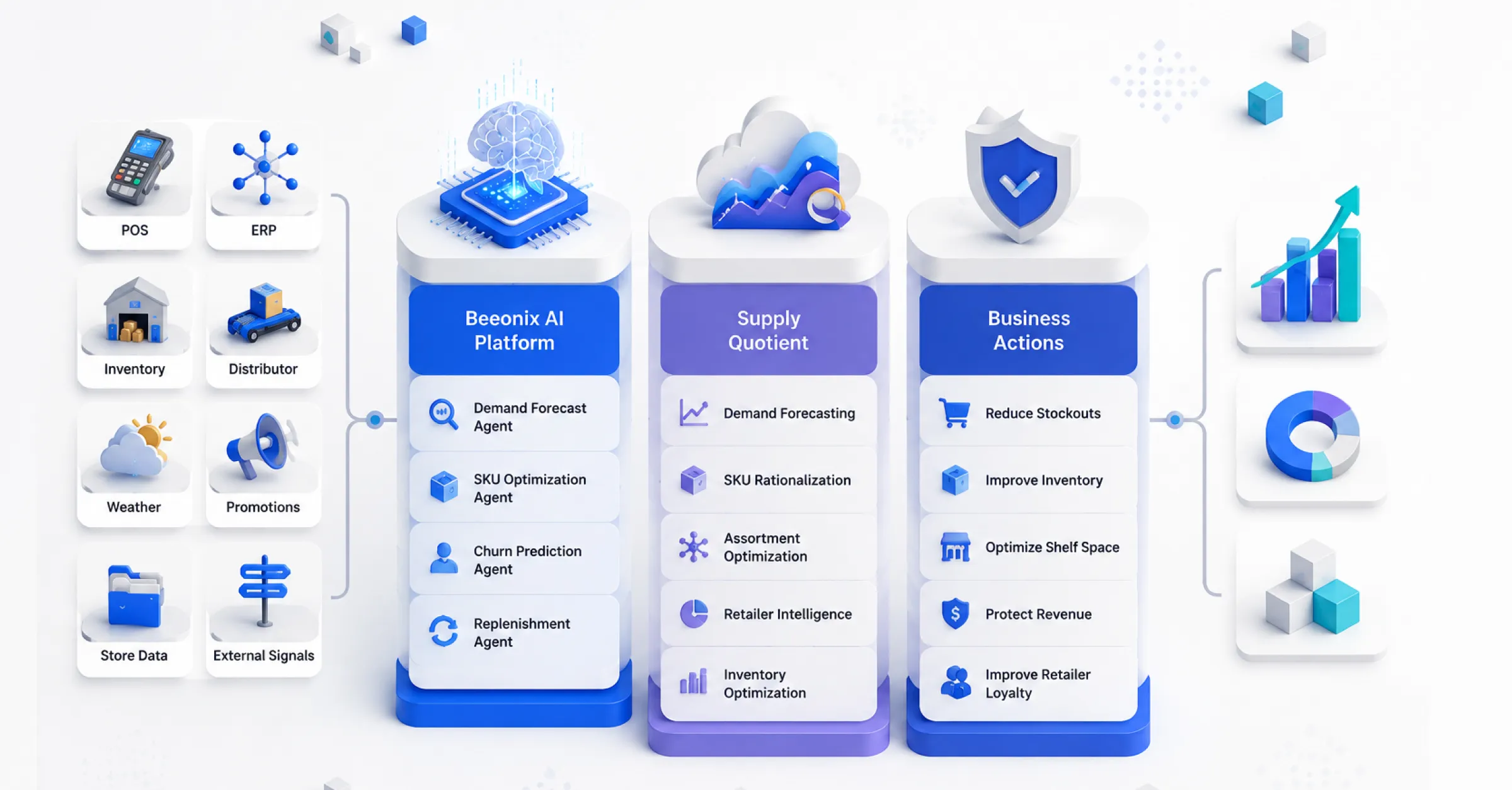
Supply Quotient is BigTapp's AI decision system for retail and FMCG supply chains. It does not replace your forecast with a better dashboard; it turns the forecast into a decision. It continuously reads the signals a supply chain runs on demand, inventory, assortment, price, weather, promotions and retailer behavior reasons about what has changed, and recommends the specific action to take, keeping a person in control of the calls that matter.
Its agents run on Beeonix, BigTapp's agentic AI platform the layer that lets them coordinate, applies the guardrails, and keeps a person in control of consequential decisions. It is what turns a set of clever models into a supply chain you can trust to act; we return to how it governs that below.
The rest of this article shows where that shift from producing a number to deciding changes the money retail loses today.
Where Rule-Based Supply Chains Lose Money
1. Stockouts — the forecast was accurate, but the shelf was empty
An average forecast cannot see store-level variation: the same SKU overshoots in one branch and runs dry in another on the same day. Supply Quotient's Demand Forecasting Agent forecasts at SKU-store level, reading seasonal patterns, weather and live promotion impact, so replenishment follows real local demand rather than a chain-wide average. The outcome is higher availability and the sales you were quietly losing to empty shelves, recovered.
2. Overstock — when safety stock becomes dead stock
Safety stock exists to absorb uncertainty but set once and left alone it slowly turns into working capital frozen on a shelf. Supply Quotient's Inventory Optimization Agent balances stock against live demand and recommends transfers between locations moving the excess in one store to the store about to run out, rather than simply reordering more. The outcome is lower working capital, less wastage, and margin that was sitting idle put back to work.
3. SKU growth without SKU intelligence
Retailers keep adding products but rarely retire from them. The result is SKU proliferation: shelves crowd with lines that earn their space and lines that merely occupy it; shelf productivity falls, and delisting decisions get made on gut feel because no one can see which SKU is truly carrying the category. Supply Quotient's SKU Rationalization and Assortment Agent settles that with evidence. It can identify whether a SKU deserves its shelf space based on velocity, margin contribution and store-cluster behavior then recommends what to delist, what to keep, and how to arrange the rest through planogram compliance and shelf optimization, cluster by cluster. The outcome here is not more sales; it is better margin from the same shelf.
4. Retailer churn happens before the revenue loss shows up
By the time a sales team notices a distributor's numbers falling, the relationship has usually been cooling for weeks. Supply Quotient's Retailer Churn Prediction Agent reads the early signals order frequency slowing, basket shrinking, engagement dropping and flags the account while there is still time to act. The outcome is intervention before the loss, not a post-mortem after it.
What Makes Supply Quotient Different: One Decision Feeds the Next
Listed separately, these look like four clever tools. What makes a supply chain autonomous rather than merely automated is that the tools inform one another one decision becomes the input to the next, without a planner stitching them together by hand.
Follow the heatwave through. The Demand Forecasting Agent picks up the spike and revises the store-level forecast. That revision hands straight to the Inventory Optimization Agent, which rebalances stock toward the stores that will need it. The same store-cluster demand also reaches the SKU Rationalization and Assortment Agent, which weighs each SKU's velocity and margin contribution to decide what deserves the shelf in that cluster — so the space works hardest where demand is moving. And where a particular retailer keeps being left short through repeated disruptions, the Churn Prediction Agent registers the rising risk and recommends the intervention before the relationship cools. One signal, carried through demand, inventory and retention as a single continuous decision of people approving the moves that matter.
Why Agentic AI Needs Governance
Autonomy without governance is just faster for automation and in a supply chain; an autonomous system is making calls that move stock, free capital and delist products. Those calls have to be explainable and controllable.
Beeonix, the platform introduced above, is the layer that makes this safe to run. It orchestrates the agents and lets them coordinate; it sets guardrails on what each agent may decide on its own; it explains the reasoning behind every recommendation; it keeps a human in the loop on the consequential moves; and it holds a full audit trail of what was decided and why. That is what separates a supply chain you can trust to act from one that simply acts faster.
Before vs After the Autonomous Supply Chain
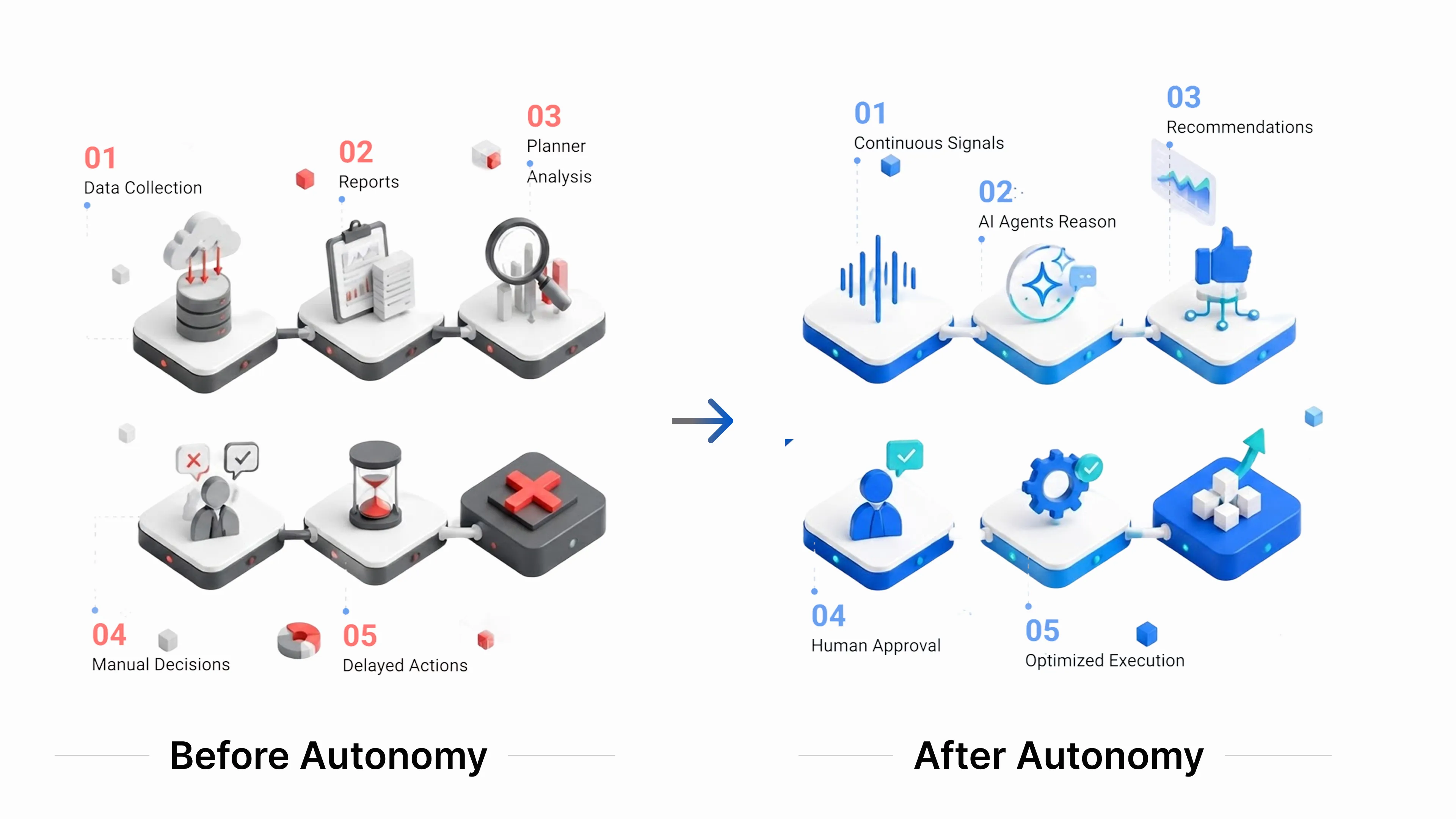
The difference is easiest to see in what happens to a single piece of information say, this week's demand for bottled water in a coastal region during an early heatwave.
Before, the data arrives in pieces that no one reconciles in time: a sales report on Monday, a separate weather note, a promotion calendar sitting in another team's inbox. A planner eventually reads them, forms a view, and places an order by which point the weekend has passed. After, those same inputs are read together as one live signal; the system reasons the combined picture, recommends the stock move for the affected stores, and a manager approves it before the shelves are ever tested.
The functional change is one thing; the business change is the point. Before, the coastal stores stock out through the hottest weekend of the season, while three inland stores marked the same water down to clear it sales lost at one end; margin lost at the other. After, availability holds through the spike, the sales that would have walked out are recovered, and no capital is wasted stocking the stores that never needed it.
The Shift That Is Already Underway
The future of retail supply chains will not belong to the organizations with the most automation. Most already have that, and it is not enough. It is precisely what is producing the empty shelves, the dead stock, and the retailers who leave without warning.
It will belong to the organizations whose supply chains can sense change, decide what to do about it, and improve with every cycle while the people accountable for the business stay in control of the decisions that matter.
That is the difference between an automated supply chain and an autonomous one.
Supply Quotient, powered by Beeonix, is built to help retailers make that shift deliberately, and with the evidence trail to trust it.
Think Big. Act Intelligent.