

Your Bank Is Fully Automated. So Why Do the Signals That Matter Still Reach You Last?

Executive summary: Banks and insurers have spent two decades automating work — payments, workflows, approvals, reports. Yet the decisions that carry the most value still arrive late, because no single system connects what one part of the institution notices to what another part should do about it. This article looks at why even intelligent automation stops short of autonomy, what autonomy actually requires — agents that coordinate, not just agents that answer — and how banks and insurers can let a decision move across functions on its own, while people stay in control of the outcome.
The BFSI Automation Paradox
Every large bank and insurer is already automated.
Payments clear straight through. Statements generate themselves. Approvals route through workflows. Reports arrive every Monday morning.
And yet.
A corporate client's litigation reaches the relationship manager through a news article. A credit account deteriorates for two quarters before anyone opens the file. A policyholder asks why a claim was rejected and is told someone will get back to them. A renewal lapses in silence, three weeks after the agent stopped hearing back.
None of this is an automation failure. Every system did exactly what it was built to do.
The design is a problem.
A Workflow Is Not a Judgement
Rule-based automation is instruction-following. If the document set is complete, route it for approval. If payment is 90 days overdue, flag the account. If the customer types 'balance', return the balance.
Rules handle what you predicted. Banking and insurance are defined by what you did not.
A borrower's largest customer files for insolvency. A wealth of client portfolio drifts overnight as markets move. A policyholder claims for damage their cover excludes. None of these trips are a rule. All of them changed their decisions.
The system followed the instructions. The business needed judgement.
The Real Gap Is Not Data. It Is Coordination.
Here is what makes BFSI different from most industries facing this problem. In nearly every scenario above, the institution already held the information. It sat in a CRM note, a news feed, a policy record, and a claim file.
The information existed. What was missing was the connection between the part of the institution that held it and the part that needed to act on it.
That connection, today, is almost always a person walking a question between departments, rekeying a figure from one system into another, remembering to follow up. It does not scale. A relationship manager covering 200 clients cannot read every filing. A service agent cannot chase every rejected claim through three departments.
This is precisely where automation stops, and autonomy begins.
What Autonomy Actually Means
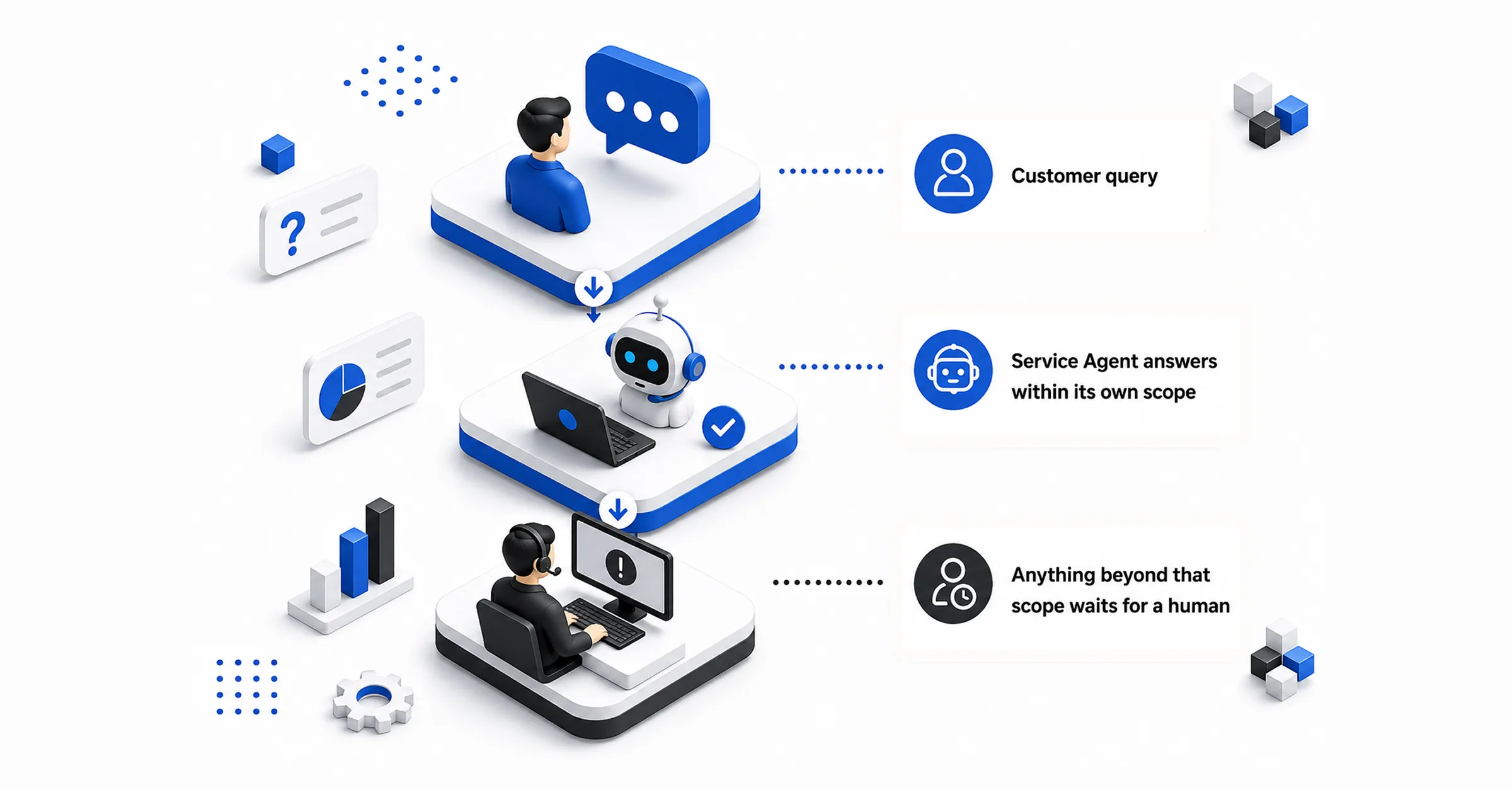
Automation executes a task you defined in advance, and it can be very good at it. A chatbot that answers a thousand customer questions is automation working well, but it is still automation. It does one job, inside one boundary, and stops at the edge of that boundary.
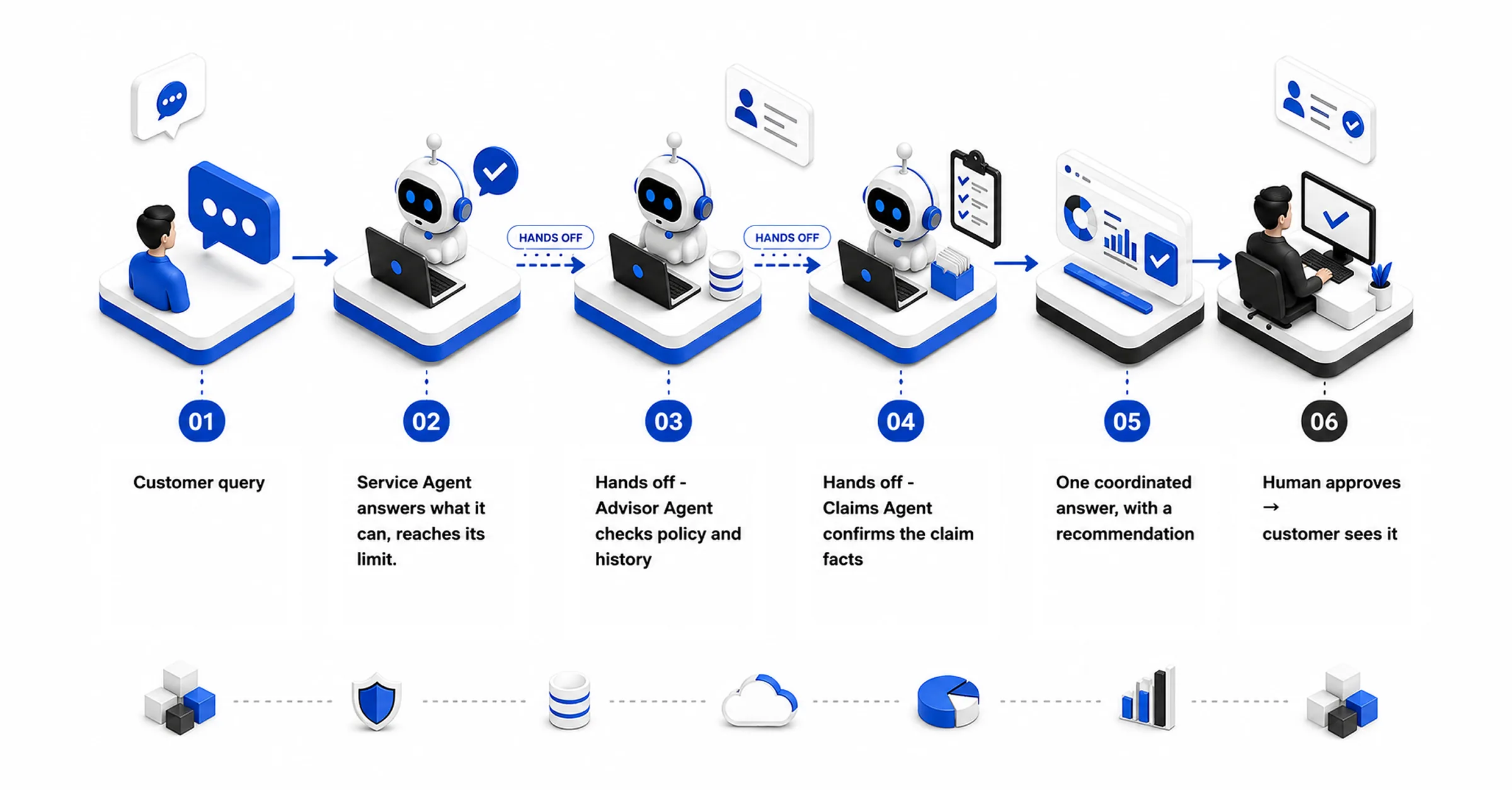
Autonomy begins at that edge. A real decision in banking or insurance rarely sits inside a single job. Answering "why was my claim rejected?" is not a service task; it needs the service function, the claims' function and the advisory function to work together before the customer gets a useful answer. In most institutions, a human is the wire between those functions.
Autonomy is what happens when that wire is no longer a person. An autonomous system is a set of agents that coordinate: one agent does its job, reaches the limit of what it knows, and hands out the problem to another agent that can take it further until the decision is complete, and a human approves the outcome.
Three differences matter:
- Automation does one task. Autonomy connects several.
- A single agent answers. Coordinated agents have decided.
- Automation stops at its boundary. Autonomy crosses it and brings a person to the finished recommendation, with the trail of how it got there.
Autonomy Begins with Trusted Data
Autonomy does not begin with an AI model. It begins with a trusted institutional memory. Before an agent can recommend anything, it has to understand the customer, the product, the policy, the risk exposure and the regulatory context it is operating in — and that understanding does not come from the model. It comes from governed data foundations, semantic models and enterprise knowledge layers that agree on what a customer, an account or an exposure actually means.
This is why successful autonomous enterprises are not the ones with the cleverest model, but the ones that combine an agentic AI platform with domain data models and accelerators. Coordination between agents is only as trustworthy as the shared definitions sitting underneath it.
BigTapp's Reference Data Model provides a foundation for BFSI. It gives the agents a consistent, governed view of the entities a bank or insurer runs on Customer and Party, Products and Accounts, Facilities, Exposure, and Transactions so that every agent reasons from the same business definitions rather than its own. That consistency is also what makes a recommendation explainable: when an agent proposes an action, the institution can trace it back to a shared, governed definition instead of a black box.
Where This Changes Banking
1. The wealth recommendation no single system could make
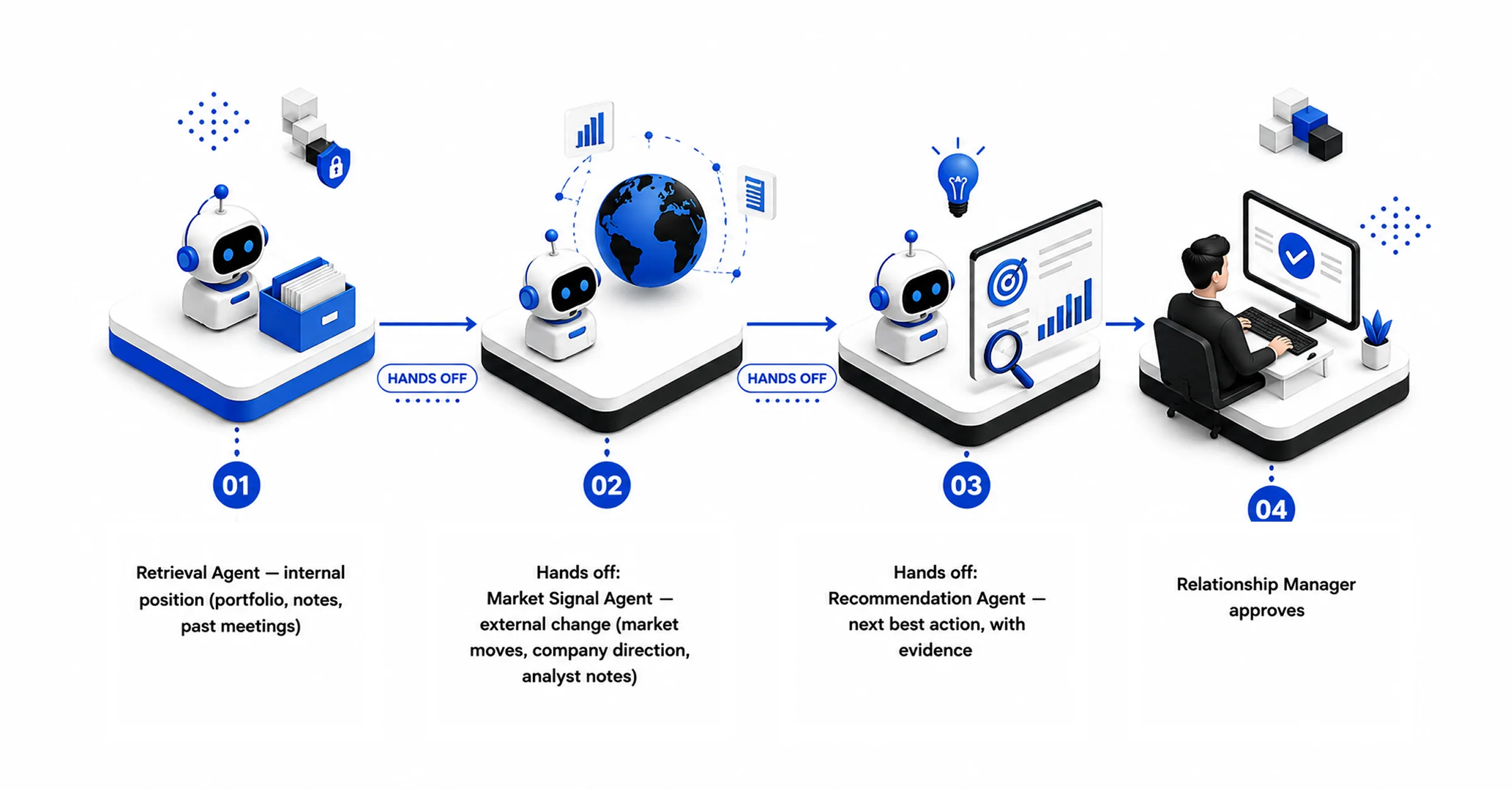
A Relationship Manager (RM) preparing for a client review needs three different things, and they live in three different places: what the bank already knows about the client, what the market has done since the last conversation, and what given both the client should now do.
BigTapp’s Relationship Manager (RM) Companion treats these three coordinating agents, not one tool.
A Retrieval Agent assembles the client's position portfolio, past meetings, internal notes, and recent transactions into a single brief. On its own, that is useful for automation: it saves preparation time and nothing more.
But internal notes cannot tell you what to recommend. So, the Retrieval Agent hands to a Market Signal Agent, which reads what the bank's own records cannot contain market movements, a company's stated direction from its annual meeting, analyst commentary and marks what has changed for this client since the last review.
Those two then hand to a Recommendation Agent, which combines the internal picture and the external signal into a specific, evidenced next best action: this client is overexposed to a sector the market has turned on; here is the reallocation to propose, and why.
The relationship manager approves it. Retrieval to market recommendations happened without anyone moving data between systems. That is the difference between producing a brief (automation) and producing a recommendation (autonomy).
2. The credit decision that keeps deciding
A credit proposal is not one decision; it is a decision that must be revisited every day after it is made.
At origination, a Proposal Agent reads statements, credit memos and filings and drafts an evidenced proposal for the credit officer to approve turning a slow manual workup into a fast one.
Autonomy is what happens after disbursement. The Proposal Agent hands the account to an Early Warning Agent that keeps watching credit behavior, adverse media, and the health of the borrower's own largest customers. When it detects deterioration, it does not simply raise a flag and wait; it coordinates with RM Companion, so the relationship manager's next brief already carries the warning and a recommended action. A signal that starts in the credit function arrives, on its own, with the person who can act on it.
Origination and monitoring stop being two disconnected events. They become one continuous decision.
Where This Changes Insurance
1. The rejected claim that answers itself
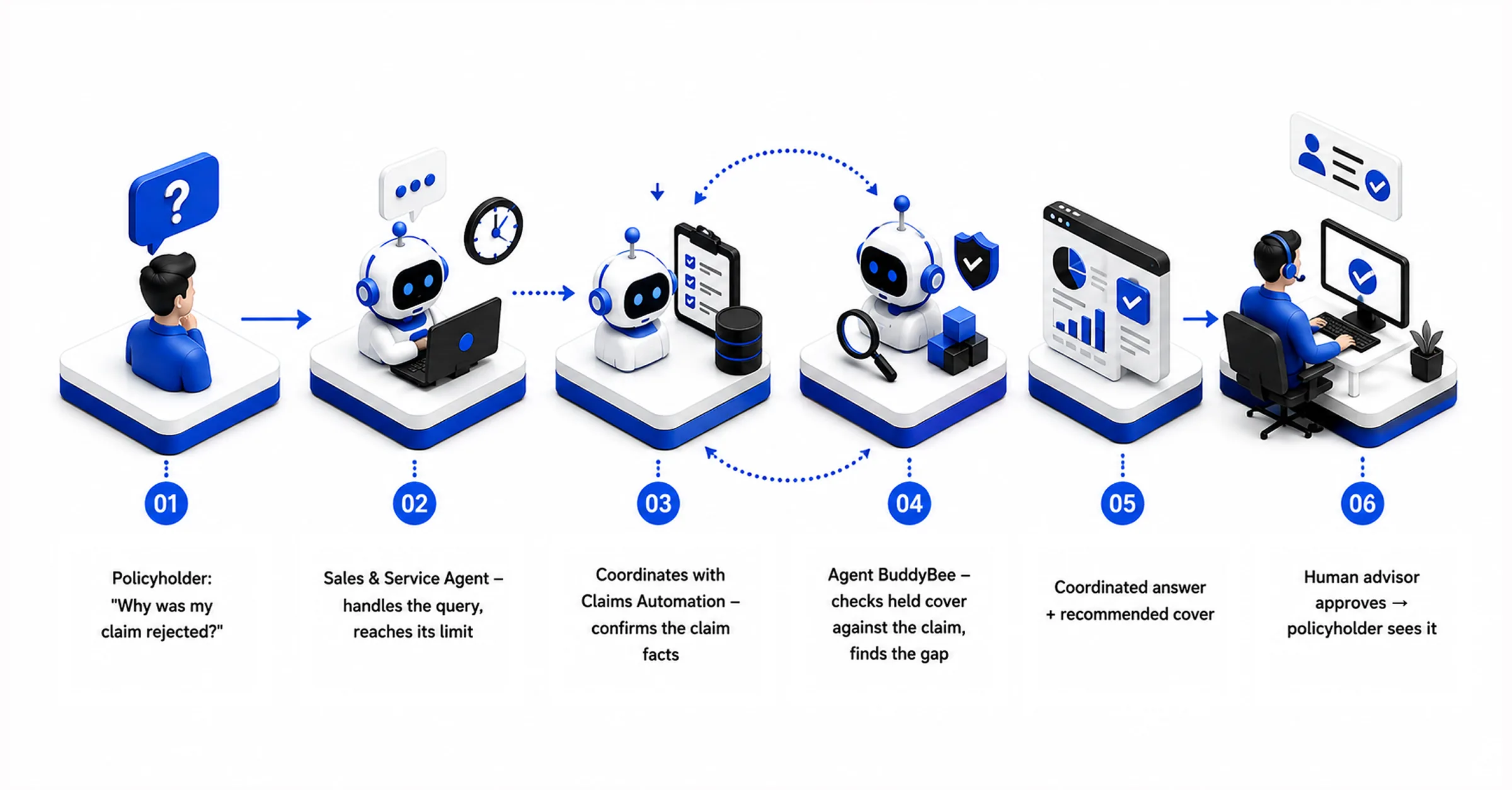
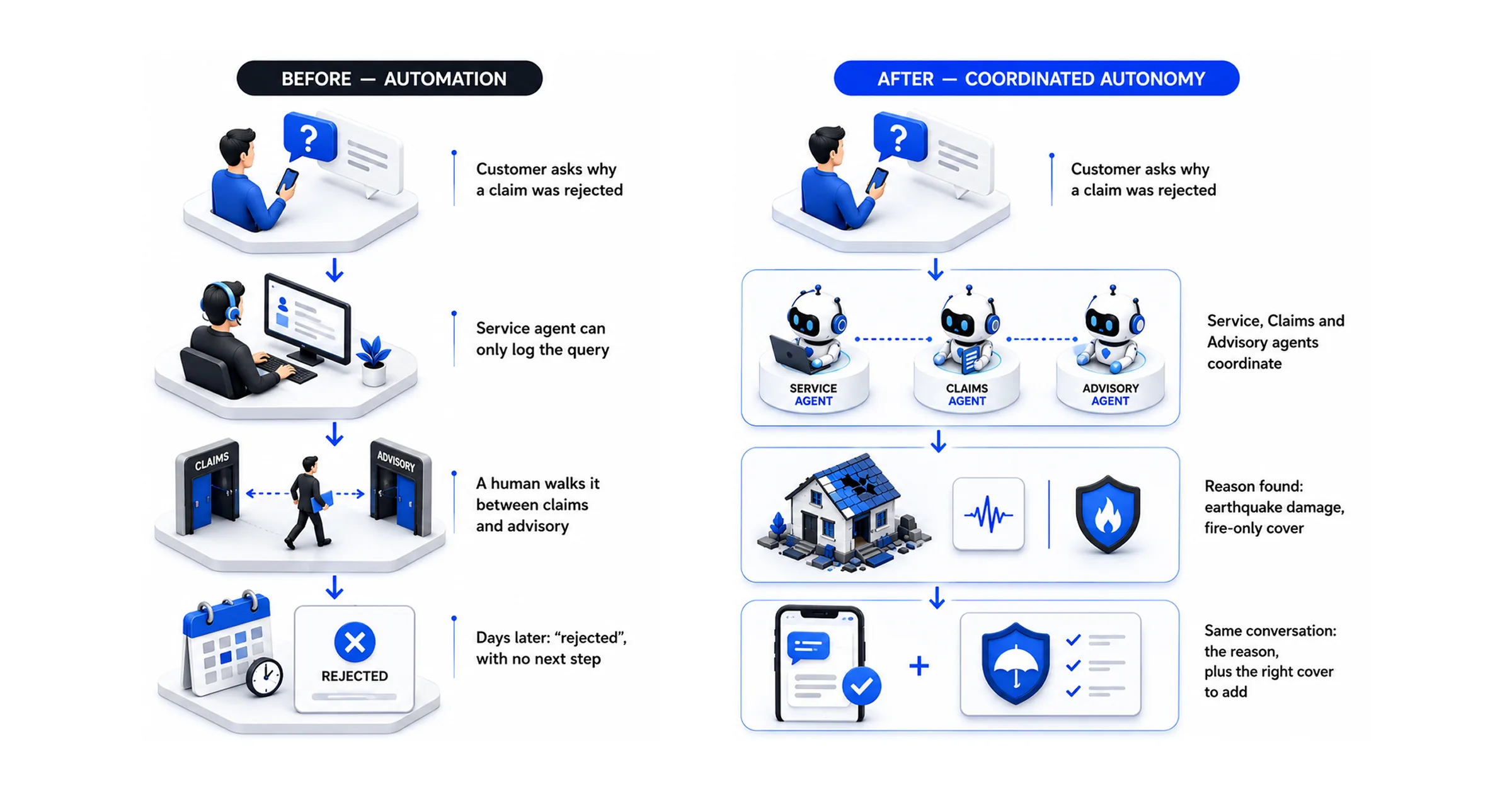
A policyholder asks a simple question: why was my claim rejected?
For a single agent, this is a dead end. The Sales & Service Agent is built to answer service and policy queries due dates, renewals, and policy status. The reason a claim was rejected does not live in its scope. In most insurers this is the moment the customer is told someone will get back to them, and a human starts walking the question between departments.
Autonomy removes the walk. The Sales & Service Agent, reaching the edge of what it knows, coordinates with two other agents. Claims Automation confirms the facts of the claim what was submitted, what was assessed. BigTapp’s Agent BuddyBee, the advisory agent, checks the policy the customer holds against what they claimed for, and finds the mismatch: the customer holds fire cover, but the damage was caused by an earthquake, which the policy does not include.
What returns is not just "rejected". It is your claim fell outside your current cover, and here is the policy that would protect you against it. One question — answered and advanced by three agents coordinating, with a human advisor approving before it reaches the customer.
The same handshake runs the other way. When Claims Automation processes a claim that falls outside a held policy, it coordinates with Agent BuddyBee to surface the coverage gap and the right recommendation turning a rejection into a retention conversation.
2. The renewal nobody chased
Lapse is usually discovered after it happens. By the time anyone notices a policyholder has gone quiet, the policy has already lapsed.
Agent BuddyBee watches the signals that preceded a lapse against a policyholder who has stopped opening messages, a renewal approaching with no contact, a claim experience that went badly. When the pattern appears, it coordinates with the Sales & Service Agent to prepare the outreach: who to call, why now, and what to offer. The distribution agent receives not a list, but a prioritized, reasoned action before the lapse, not after it.
The Layer That Makes It One Institution
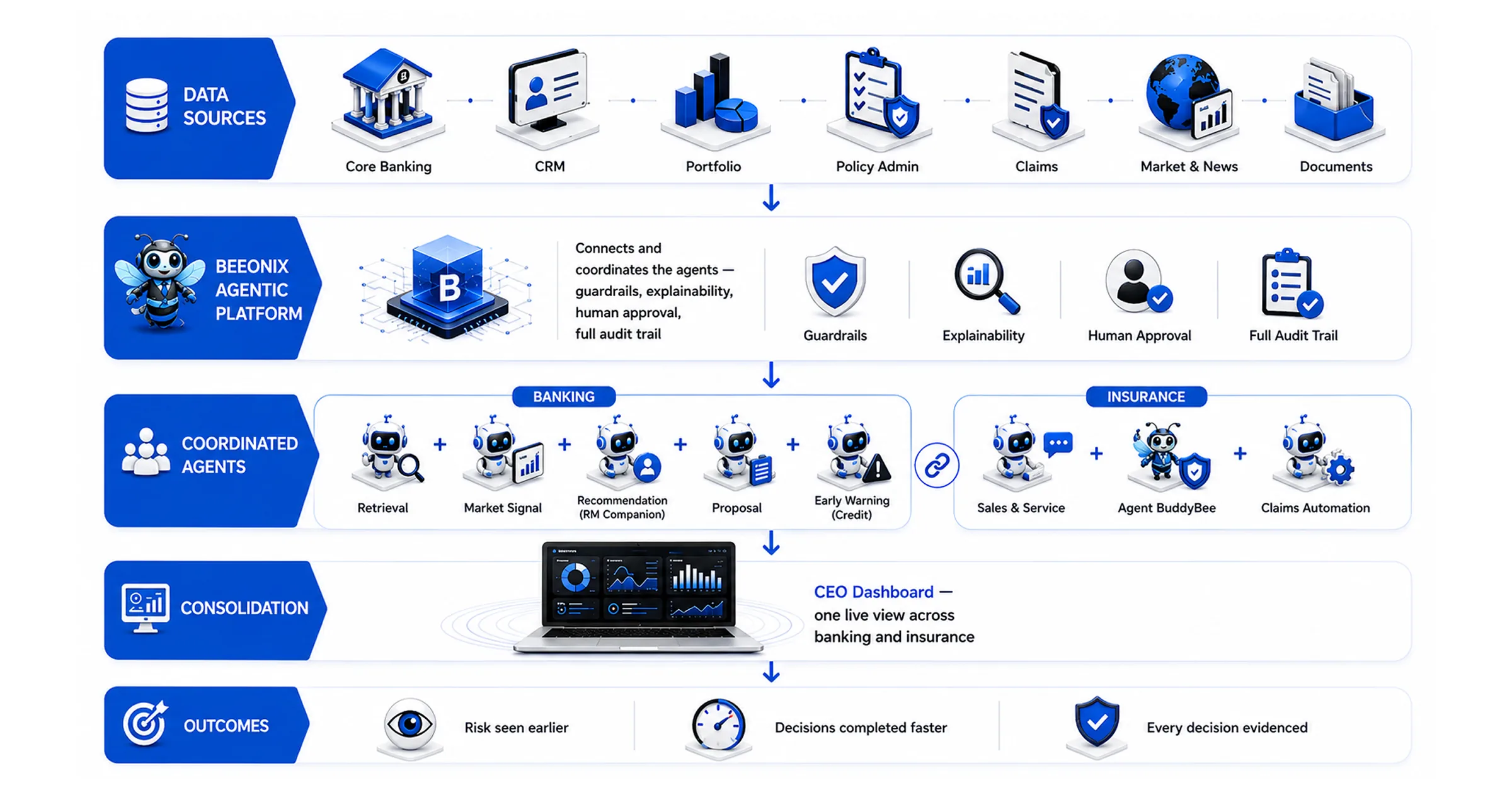
Deployed separately, these are useful tools. Deployed so they can coordinate, they become one institution.
The same deterioration signal an Early Warning Agent detects updates the relationship manager's brief, informs the next credit review, and appears on BigTapp’s CEO Dashboard as a movement in portfolio quality the same event, understood once, reaching everyone who needs it, without anyone rekeying it.
That is the difference between an automated bank and an autonomous one. Not more tools. Agents that coordinate.
Autonomy Without Governance Is Just Faster Automation
Coordination between agents is exactly what a regulator will question hardest. If one agent can hand a decision to another, what stops it doing something it should not? What did each agent see? Who approved the outcome?
This is why coordination cannot be improvised. Beeonix, BigTapp's agentic platform, is the layer that lets the agents coordinate at all connecting them, governing which agent may hand what to which, and enforcing the rules at every step: guardrails on what each agent can access and do, human approval on consequential decisions, an explanation for every recommendation, and a full audit trail of the handoffs. Alongside it, IDP turns unstructured documents statements, credit memos, claim invoices into decision-ready data the agents can act on.
A set of agents that can pass work to each other without that governance is not autonomy. It is just faster automation. Beeonix is what makes the coordination safe enough to run in a regulated institution.
What Changes for the Business
Autonomy changes to specific moments, not abstractions.
The claim that would have taken four days and three phone calls is answered, correctly and with a recommendation, in a single conversation. The wealth review that an RM once opened with last quarter's picture now begins with this week the portfolio, the market and the client's position all current on the day of the meeting. The credit warning that used to surface at default surfaces as a trend, in the brief of the person who can act on it. The renewal that would have lapsed in silence becomes a call made in time.
In each case, the pattern is the same: a decision that used to wait for a human to carry it between functions now moves on its own and arrives, finished, for a human to approve.
The Shift That Is Already Underway
Banking spent the last decade becoming data-driven dashboards, reports, and lagging indicators. The next decade belongs to institutions where the functions that each hold one piece of a decision can act together, without waiting for a person to connect with them.
The winners will not be the institutions with the most agents, or the most automation. Most will have plenty of both. They will be the institutions whose agents coordinate where noticing something in one corner of the business becomes a decision, and an action, across all of it, in time to matter.
That is the difference between an automated enterprise and an autonomous one.
BigTapp's Beeonix and BFSI solution packs are built to help banks and insurers make that shift deliberately, and with the evidence trail their regulators expect.
Think Big. Act Intelligent.